

You envision a space of pure serenity. A deep, freestanding bathtub, the centrepiece of your personal sanctuary. But a quiet worry interrupts this dream: Is it too heavy for my HDB flat? This concern is more than just a fleeting thought; it is a crucial step towards a safe and harmonious renovation. Understanding the official hdb bathroom weight limit can feel daunting, clouded by technical terms and the fear of overlooking critical HDB rules.
Creating your dream retreat should be an inspiring journey, not a stressful one. This guide is designed to bring you clarity and confidence. We will translate the technical details into simple steps, show you how to calculate your bathroom’s total load, and help you select a timeless bathtub that perfectly balances elegance with structural integrity. Your tranquil, spa-like escape is within reach, built on a foundation of safety and peace of mind.
Key Takeaways
- Discover the official HDB structural guideline, translated into simple terms to ensure your sanctuary is built on a foundation of safety.
- Master a simple calculation to determine the total weight of your chosen bathtub, water, and yourself, ensuring your design choices remain compliant.
- Explore how elegant material choices and intelligent design can create a luxurious retreat, all while respecting the official hdb bathroom weight limit.
- Navigate the complete renovation process with confidence, from essential waterproofing rules to engaging the right professionals for a seamless transformation.
Understanding the Official HDB Bathroom Weight Limit
Creating a personal sanctuary begins with a foundation of safety and understanding. As you envision elegant fixtures and luxurious finishes for your bathroom, a crucial yet often overlooked detail is the official hdb bathroom weight limit. This guideline isn't meant to restrict your creativity; rather, it ensures that your dream space is both beautiful and structurally sound for years to come.
What is the HDB Structural Load Limit?
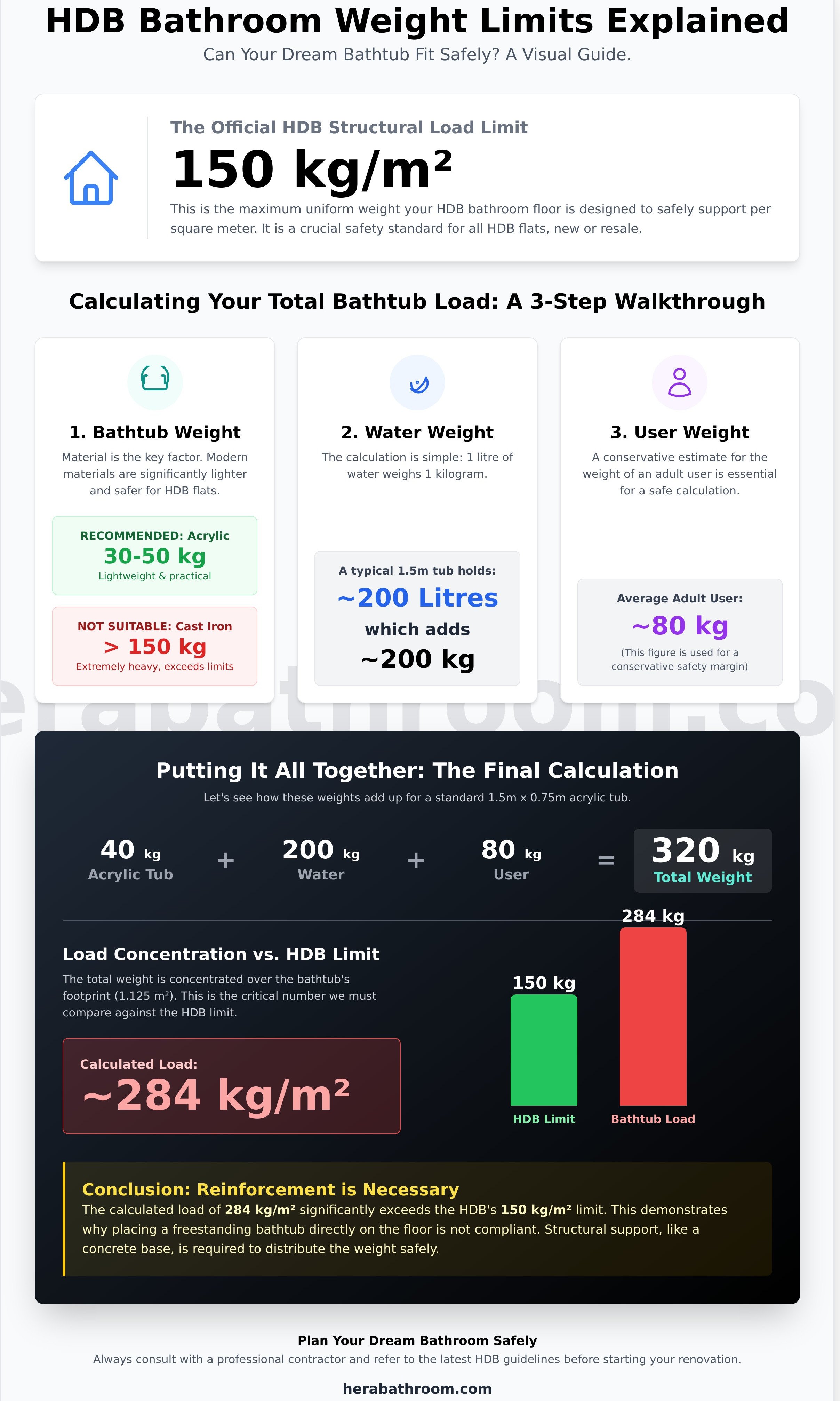
The permissible imposed load for HDB bathrooms is set at 1.5 kilonewtons per square meter (kN/m²). In simpler terms, this translates to approximately 150 kg per square meter. Imagine this as the maximum weight the floor is designed to consistently support across every one-meter by one-meter area. This standard is a core component of Singapore's building code, enforced by the Housing & Development Board (HDB) to maintain the structural integrity of public housing.
Why This Weight Limit is Crucial for Your Safety
Your home is a retreat, and its structural integrity is the silent guardian of that peace. In a high-rise building, each floor is part of an interconnected system. Exceeding the weight limit with excessively heavy flooring, fixtures, or features can place undue stress on the floor slab and supporting beams. Over time, this could compromise the structure, ensuring respect for the hdb bathroom weight limit is an essential act of care for your family and your neighbours below.
Does the Limit Apply to All HDB Flats (BTO vs. Resale)?
This foundational safety standard of 1.5 kN/m² is a consistent benchmark for both new BTO (Build-To-Order) flats and most older resale units. It provides a uniform guideline for all homeowners and renovation professionals. However, for very old flats, it is always a mark of wisdom to seek professional consultation before planning significant alterations. As guidelines can be updated, we always recommend referencing the latest HDB circulars to ensure your design plans are in perfect harmony with current regulations.
Calculating Your Bathroom's Total Load: A Practical Walkthrough
Transforming your bathroom into a personal sanctuary begins with understanding the space itself. While the concept of a weight limit may seem technical, calculating your potential load is a straightforward process. It empowers you to select fixtures that bring serenity without compromising structural integrity. This simple walkthrough demystifies the numbers, ensuring your design choices are both beautiful and sound.
The total weight, or 'live load', is primarily composed of three elements: the bathtub, the water it holds, and the user(s).
Step 1: The Weight of the Bathtub Itself
The material of your chosen bathtub is the foundation of this calculation. A traditional cast iron tub can weigh over 150 kg even when empty, making it unsuitable for most HDB installations. In contrast, modern acrylic bathtubs are crafted to be exceptionally light, typically weighing between 30 kg and 50 kg. Their minimalist forms and lightweight nature make them an elegant and practical solution for creating a spa-like retreat within HDB constraints.
Step 2: The Weight of the Water
Calculating water weight is beautifully simple: one litre of water weighs exactly one kilogram. You can find the water capacity of a bathtub in its product specifications. A common 1.5-metre freestanding tub holds approximately 180 to 220 litres of water. This translates directly to 180 to 220 kg of additional weight when the tub is filled for a luxurious soak.
Step 3: The Weight of the User
The final component is the weight of the person or people enjoying the bath. For a safe and conservative estimate, it's wise to factor in the average weight of an adult. A practical figure for this calculation is 80 kg for a single user. This completes the three core elements that contribute to the total live load on your bathroom floor.
Putting It All Together: A Sample Calculation
Let's combine these elements to understand the true load per square metre, which is the critical figure for the hdb bathroom weight limit. We'll use a standard 1.5m x 0.75m acrylic tub as our example.
- Bathtub Weight: 40 kg (Lightweight Acrylic)
- Water Weight: 200 kg (Approx. 200 Litres)
- User Weight: 80 kg (One Adult)
- Total Weight: 40 + 200 + 80 = 320 kg
Next, we calculate the load concentration by dividing the total weight by the bathtub's footprint (Area = Length x Width).
- Footprint: 1.5m x 0.75m = 1.125 m²
- Load per m²: 320 kg / 1.125 m² = ~284 kg/m²
This result of 284 kg/m² is significantly higher than HDB's stipulated 150 kg/m² limit for a bathroom floor. This calculation clearly illustrates why simply placing a bathtub is not feasible and why structural reinforcement, such as a concrete plinth, is essential. These figures don't even account for floor finishes, which are also covered by the Official HDB renovation guidelines, making professional consultation a vital step in your renovation journey.
Designing Your Sanctuary Within the Limits
A weight limit is not a restriction; it is a parameter that inspires creativity. The art of designing a serene HDB bathroom lies in making intelligent, elegant choices that work in harmony with the structure of your home. By focusing on sophisticated materials and smart design, you can create a personal sanctuary that feels luxurious and expansive, all while respecting the established hdb bathroom weight limit.
The journey begins with understanding that every element contributes to the whole. It’s about curating a space where form and function achieve a perfect, lightweight balance.
The Elegance of Lightweight Materials
The material of your bathtub is the single most significant factor in its overall weight. While traditional materials like cast iron or stone resin offer a classic look, their immense weight often makes them unsuitable for HDB installations. Instead, consider the refined appeal of high-quality acrylic. Modern acrylic bathtubs are a testament to innovation, offering:
- Excellent Heat Retention: Warm to the touch, acrylic keeps your bathwater warmer for longer, enhancing your moments of serenity.
- Timeless Durability: Resistant to chipping and cracking, its non-porous surface ensures a flawless finish that lasts.
- Effortless Maintenance: Simple to clean, it allows you to spend more time relaxing and less time on upkeep.
Smart Bathtub Designs for HDB Spaces
Beyond material, the design of your bathtub plays a crucial role in weight management. A built-in or alcove bathtub, for instance, intelligently distributes its load across supporting walls, making it an inherently stable choice. Freestanding tubs, the pinnacle of bathroom luxury, can also be a perfect fit when selected with care. Look for compact, thoughtfully crafted designs with a footprint that spreads the weight evenly, avoiding concentrated pressure points on your floor.
Considering Other Fixtures: Vanities, Basins, and Tiles
Your bathtub does not exist in isolation. The total structural load includes every fixture and finish within the space. This is a core principle of building safety, governed by regulations under Singapore's Building Control Act. To maintain a harmonious balance, consider elegant, space-saving vanity cabinets and minimalist basins that offer full functionality without unnecessary bulk. Even the thickness of your floor screed and the type of tiles you select contribute to the final weight, making a holistic design approach essential for compliance and peace of mind.
Beyond Weight: Other Essential HDB Renovation Rules
Crafting your bathroom sanctuary is an art, but it is also a science guided by essential regulations. Beyond the crucial hdb bathroom weight limit, a truly harmonious renovation respects the structural and communal integrity of your HDB flat. Understanding these rules ensures your retreat is not only beautiful but also safe, compliant, and built to last. A qualified professional is your essential partner in navigating these details with grace and precision.
Waterproofing: Your First Line of Defence
The unseen foundation of a serene bathroom is its waterproofing. HDB mandates a robust waterproofing membrane for all wet areas, a critical layer that protects your home and your neighbours below. For new BTO flats, this original waterproofing layer is protected by a three-year restriction period, during which it cannot be removed or tampered with. Honouring this rule is fundamental to preventing ceiling leaks and maintaining harmony within your block.
Plumbing and Sanitary Pipework Regulations
The flow of water is the lifeline of your space, and its pathways are strictly governed. HDB regulations do not permit the alteration, relocation, or concealment of existing sanitary pipes. All plumbing work, from installing a new rain shower to fitting a bespoke basin, must be carried out by a PUB-licensed plumber. This ensures that every connection is sound, secure, and adheres to national standards, safeguarding your home against potential water damage.
Wall and Floor Finishes: The Thickness Limit
The choice of tiles and finishes defines the aesthetic of your sanctuary, but their application is a matter of technical compliance. HDB stipulates that the total thickness of floor finishes, including the cement screed and tiles, must not exceed 50mm. This guideline works in tandem with the overall hdb bathroom weight limit to manage the load on the floor slab. Choose elegant, lightweight tiles and consult your contractor on using the correct adhesive thickness to achieve a flawless and compliant finish.
Navigating these regulations is key to creating a space that brings you peace of mind. Crafting your personal sanctuary requires a partner who values both elegance and compliance. Explore our timeless collections to find inspiration for your beautifully compliant bathroom retreat.
The Renovation Process: A Checklist for Peace of Mind
Embarking on a bathroom renovation is the first step toward crafting your personal sanctuary. A seamless transformation is built on a foundation of careful planning and adherence to guidelines. This ensures your new space is not only beautiful and serene but also safe and fully compliant. Let us guide you through the essential steps.
Engaging the Right Professionals
Your vision requires the right hands to bring it to life. An interior designer can help you craft the aesthetic and layout, while an HDB-licensed contractor is essential for the technical execution. For any structural or wet works, hiring a licensed contractor is mandatory. Always verify their credentials on HDB’s official directory and ask to see a portfolio of their completed bathroom projects to ensure their craftsmanship aligns with your vision of elegance.
Permits and Approvals: When Do You Need Them?
Navigating HDB regulations can be simple. Replacing an existing bathtub often does not require a permit, provided no walls or flooring are hacked. However, more extensive works do. A permit is typically necessary for:
- Hacking or moving walls to create a more open space.
- Replacing the entire floor or wall finish.
- Repositioning sanitary fittings like sinks and toilets.
Your licensed contractor is responsible for submitting all required permit applications, allowing you to focus on the design details of your retreat.
Your Pre-Renovation Safety Checklist
With a clear plan, you can proceed with confidence. This final checklist ensures every detail is considered, respecting both your design aspirations and the structural integrity of your home. Before work begins, ensure you have:
- Confirmed your specific hdb bathroom weight limit with HDB or building management.
- Calculated the total load of your new bathtub, tiles, and fixtures.
- Selected beautiful, lightweight materials where possible.
- Engaged only HDB-licensed renovation professionals.
- Reviewed HDB’s latest guidelines on waterproofing and renovations.
Ready to design your sanctuary? Explore our curated bathtub collection.
Your Sanctuary, Built on a Foundation of Serenity
Your journey towards a personal retreat begins with understanding. By grasping the essentials of load calculation and HDB’s renovation rules, you transform limitations into a framework for inspired design. Navigating the hdb bathroom weight limit is not about restriction; it is about the quiet confidence that comes from building your dream space safely and correctly. This knowledge is the true foundation for your peace of mind.
At HERA Bathroom, we believe elegance should never be a compromise. As specialists in crafting serene solutions for HDB and BTO homes, we understand this delicate balance. Our designs blend timeless elegance with practical function, culminating in a curated collection of lightweight, high-quality acrylic bathtubs. Each piece is chosen to bring harmony to your space, ensuring your vision for a spa-like escape becomes a beautiful, attainable reality.
Begin your journey to a personal sanctuary. Explore our HDB-friendly bathtub collection. Your moment of tranquility awaits.
Frequently Asked Questions
Can I install a jacuzzi or a stone bathtub in my HDB flat?
Creating your personal sanctuary with a statement bathtub is a beautiful vision. While possible, installing a heavy stone or jacuzzi bathtub requires careful planning. These luxurious pieces often exceed HDB's standard floor load limits. This means you will need a Professional Engineer's assessment and formal HDB approval to ensure the structural integrity of your space is maintained. Lighter, elegant acrylic options often present a more seamless path to achieving your dream retreat.
What happens if I exceed the HDB bathroom weight limit?
Respecting the structural harmony of your home is paramount. Exceeding the HDB bathroom weight limit can compromise the building's integrity, potentially causing damage to your floor and the unit below. HDB may require the unauthorised installation to be removed at your own expense. Ensuring compliance is the first step in crafting a sanctuary that is not only beautiful but also safe and enduring. It protects your peace of mind and your investment.
Do I need to hire a Professional Engineer (PE) to endorse my bathtub installation?
For heavier, more substantial bathtubs, a Professional Engineer (PE) is an essential partner in bringing your vision to life. A PE endorsement is required by HDB if the total weight of your chosen piece, when filled, exceeds the permissible load. They will conduct a detailed structural assessment and submit the necessary calculations for HDB's approval. This ensures your installation is both safe and officially sanctioned, allowing you to relax in complete serenity.
How can I be sure my contractor is following all the HDB rules?
The creation of your retreat should be a seamless experience. Entrust this journey to an HDB-registered contractor. Always request to see their credentials and ask for proof of permit submissions before any work begins. For a significant installation like a bathtub, ensure they engage a PE where necessary. A transparent, professional partnership is key to crafting a space that adheres to all regulations, ensuring its timeless quality and your complete peace of mind.
Is it possible to have a bathtub in a very small HDB or BTO bathroom?
Elegance is not defined by scale. Even the most intimate HDB or BTO bathroom can be transformed into a tranquil escape with a bathtub. Consider our collection of compact, space-efficient designs, such as Japanese-style soaking tubs. These pieces are crafted to offer a deep, immersive experience without demanding a large footprint. With thoughtful planning, a luxurious bathing ritual can become a beautiful reality in any home, proving that serenity has no size requirement.
Does the weight limit change if I want to place the bathtub outside the original bathroom space?
Placing a bathtub in an unconventional space, such as a bedroom, is a bold statement of personal luxury. However, it is vital to note that the floor load capacity outside of designated "wet areas" like bathrooms is significantly lower. This type of bespoke installation will almost certainly require a comprehensive structural assessment and endorsement from a Professional Engineer. This ensures your creative vision is realised with the utmost attention to structural safety and HDB compliance.