
Your toilet bowl is the quiet architect of your bathroom's entire geometry. Most homeowners searching for a toilet bowl in Singapore focus on price or brand, yet it's the form, the footprint, and the flush that truly determine whether your private retreat feels serene or simply functional. That single fixture anchors the space, and choosing it deserves the same considered attention you'd give to any other element of your home sanctuary.
You already know the frustration. The technical jargon feels impenetrable, terms like S-trap and P-trap read like a plumber's riddle, and the fear of installing something too bulky in a compact HDB bathroom is entirely valid. Water efficiency is a genuine concern too, not just for the environment, but for the quiet discipline of a well-managed home.
This guide cuts through all of it with calm clarity. You'll discover how to decode the essential technical considerations without losing sight of what matters most: a sleek, enduring design that performs beautifully and fits your space with intention. From trap configurations and flush ratings to the fluid lines that define a minimalist aesthetic, everything you need to make a confident, considered choice is here.
Key Takeaways
- Your water closet is more than a fixture — it is the foundational element of a restorative zone, and choosing it with intention shapes both the hygiene and the tranquility of your entire bathroom.
- Selecting the right toilet bowl in Singapore requires understanding local plumbing configurations like S-trap and P-trap offsets, as well as PUB WELS ratings that ensure your choice meets water conservation standards.
- The decision between wall-hung and floor-mounted designs carries significant visual weight, and the right choice can transform even the most compact HDB or BTO bathroom into a space that feels open and considered.
- Material quality and surface glazing are not purely aesthetic choices — non-porous finishes directly determine how effortlessly your water closet maintains its pristine appearance over time.
- A truly curated bathroom sanctuary emerges when your water closet's geometry is chosen in harmony with your vanity and basin, creating a cohesive, serene environment rather than a collection of isolated fixtures.
The Foundation of Your Restorative Zone: Understanding the Water Closet
A bathroom is never just a room. At its best, it's a private threshold, a place where the day begins with intention and ends with release. Within that space, every fixture carries weight, but none more so than the water closet. It is the anchor. The element around which everything else finds its proportion.
Quiet luxury, as a design philosophy, isn't about visible expense. It's about the considered absence of anything unnecessary. A water closet that embodies this principle sits in the room with a kind of serene authority, its silhouette clean, its surface immaculate, its presence felt without demanding attention. That quality of restrained refinement is precisely what elevates a functional bathroom into a restorative zone.
The shift in how Singaporean homeowners approach this fixture is genuine and significant. Where previous generations prioritised durability above all else, today's discerning buyer is asking a more layered question: does this piece belong here? Does it contribute to the calm I'm trying to create?
One-Piece vs. Two-Piece Designs
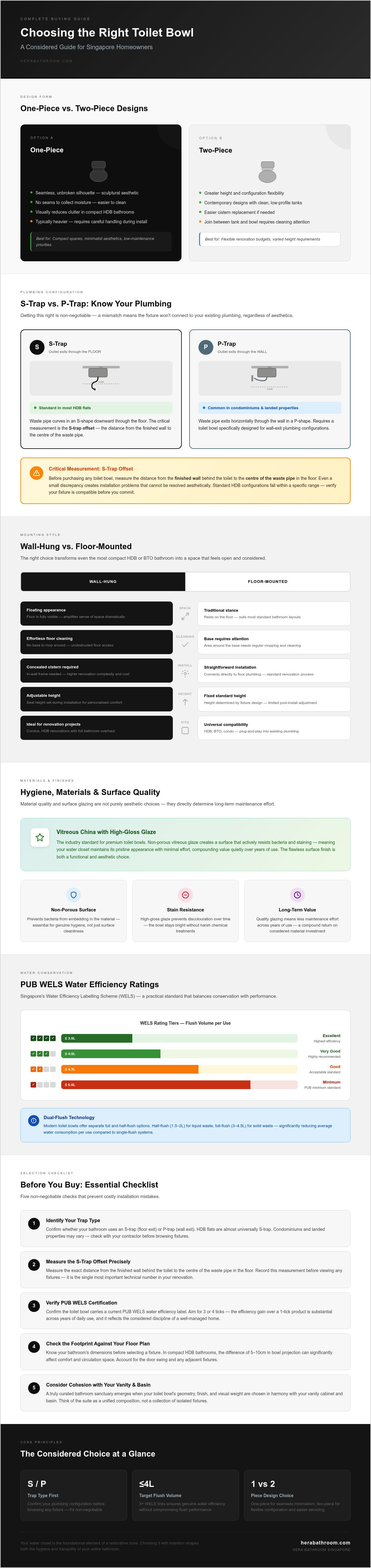
The choice between a one-piece and two-piece toilet bowl in Singapore is, at its core, an aesthetic and spatial decision as much as a practical one. A one-piece design, where the tank and bowl are formed as a single continuous unit, offers an unbroken silhouette that reads as sculptural rather than assembled. In compact HDB bathrooms, that seamlessness visually reduces clutter and amplifies the sense of space. There are no seams to collect moisture, no joins to interrupt the eye's natural flow across the room.
Two-piece models, where the cistern sits separately atop the bowl, carry their own quiet appeal. They tend to offer greater flexibility in height and configuration, and contemporary two-piece designs have shed their utilitarian origins entirely. Clean, low-profile tanks and refined bowl geometries mean they can hold their own in a considered interior without compromise.
The Evolution of the Modern Water Closet
The modern water closet has moved well beyond its industrial origins. Today, it occupies the same design conversation as your vanity cabinet or basin, its form considered with the same precision as any piece of curated furniture. Finishes matter here: a flawless vitreous glaze doesn't simply look refined, it resists staining and simplifies maintenance in ways that compound quietly over years of use.
In Singapore's BTO renovation landscape, this shift is particularly visible. Homeowners investing in their first space are increasingly drawn to fixtures with fluid lines and considered proportions, pieces that feel intentional rather than incidental. A well-chosen water closet doesn't just serve the room. It defines it.
Technical Precision: S-Trap, P-Trap, and Flushing Mechanics
Beauty without function is simply decoration. A water closet earns its place in a restorative zone by performing flawlessly, and that performance begins long before the fixture arrives, in the plumbing configuration hidden beneath your floor. Getting this right isn't complicated, but it does require knowing which questions to ask.
Navigating Singapore's Plumbing Standards
The first distinction to understand is the difference between an S-trap and a P-trap. In most HDB flats, the waste outlet exits downward through the floor, forming the characteristic S-curve of the S-trap. In condominiums and some landed properties, the outlet exits horizontally through the wall, creating the P-trap configuration. Choosing a toilet bowl designed for the wrong trap type means the fixture simply won't connect to your existing plumbing, regardless of how refined it looks.
The single most critical measurement in your renovation is the S-trap offset: the distance from the finished wall behind the toilet to the centre of the waste pipe in the floor. Standard HDB configurations typically fall within a specific range, and your chosen water closet must be compatible with that measurement. Even a small discrepancy can create installation complications that no amount of aesthetic intention can resolve. Before you commit to any fixture, measure this distance precisely and confirm compatibility with your supplier.
Water efficiency carries equal weight here. PUB's Water Efficiency Labelling Scheme (WELS) rates toilet bowls on a tiered system, and Singapore's building regulations require a minimum standard for all new installations. A higher WELS rating signals genuine conservation performance, not just a marketing claim. It's a quiet discipline built into the fixture itself.
High-Efficiency Flushing Systems
The flush mechanism shapes the daily experience of your bathroom more than almost any other technical detail. Two primary systems define the market:
- Washdown flush: Water rushes directly into the bowl from the rim, clearing waste through force. It's direct, efficient, and tends to produce a quieter operation, making it well-suited to the considered calm of a private bathroom.
- Siphonic flush: A siphoning action draws waste through the trap, producing a more powerful but often louder flush. Common in older installations, it's gradually giving way to refined washdown designs in contemporary Singaporean interiors.
Rimless bowl geometry deserves particular attention. By eliminating the concealed channel that runs beneath a traditional rim, rimless designs remove the hidden surface where bacteria and mineral deposits accumulate. The result is a bowl that's genuinely easier to keep immaculate, not just visually, but hygienically.
Dual-flush technology completes the picture. The choice between a full flush and a reduced flush for liquid waste isn't merely practical; it's a form of mindful consumption that aligns with a considered approach to home management. For a toilet bowl in Singapore's climate, where water consciousness is part of responsible living, this feature shifts from optional to essential.
Exploring the full range of water closets at HERA Bathroom offers a considered starting point, where technical compliance and refined design exist in quiet harmony.
Sculpting Space: Wall-Hung vs. Floor-Mounted Solutions for HDBs
Space is not just a physical measurement. In a compact HDB bathroom, it's a feeling. The distance between fixtures, the visibility of the floor, the way light travels across an uninterrupted surface — these are the quiet variables that determine whether a small room feels constrained or genuinely serene. Your choice of mounting style for a toilet bowl in Singapore shapes all of it.
A cluttered floor communicates clutter to the mind. That's not a design philosophy — it's simply how we experience enclosed spaces. When you choose a fixture with spatial intention, you're not just solving a practical problem. You're making a deliberate commitment to calm.
For deeper inspiration on working with compact layouts, small bathroom design ideas for HDB and BTO flats offer a considered starting point for understanding how every fixture decision compounds into a cohesive whole.
The Minimalist Appeal of Wall-Hung Toilets
A wall-hung toilet achieves something quietly remarkable: it lifts itself out of the room's geometry. With the bowl suspended above the floor, the eye reads the full length of the tile surface beneath it, and that unbroken plane makes even a narrow bathroom feel more open than its dimensions suggest. It's an illusion, but a genuinely effective one.
The practical benefits compound this visual clarity. A clear floor is simply easier to clean. There are no base curves to navigate around, no concealed ledges where moisture accumulates. Maintenance becomes effortless rather than effortful, which matters in Singapore's humid climate where hygiene is a daily discipline, not a periodic concern.
Installation does require careful consideration. Wall-hung designs rely on a concealed cistern housed within a carrier frame built into the wall cavity. This means adequate wall depth and structural reinforcement are prerequisites. In most HDB renovations, this is achievable, but it should be confirmed with your contractor before committing to the design. The investment in preparation, however, is repaid every single day in the quality of the space it creates.
Optimizing Floor-Mounted Closets for BTO Bathrooms
Floor-mounted designs remain the more straightforward installation choice, and contemporary versions have moved entirely beyond the utilitarian forms of previous decades. Two configurations deserve particular attention in a BTO context:
- Close-coupled models integrate the cistern directly onto the bowl in a single continuous profile. The result is a compact, self-contained silhouette that sits neatly against the wall without visual gaps or awkward spacing.
- Back-to-wall designs take this further by concealing the cistern within a wall-mounted unit or furniture panel, presenting only the clean bowl form to the room. The effect approaches the visual serenity of a wall-hung toilet without the structural complexity.
Silhouette matters here as much as configuration. A floor-mounted toilet bowl in Singapore's typical BTO bathroom reads very differently depending on whether its lines are compact and low-profile or tall and blocky. Choosing a design whose proportions echo those of your vanity cabinet creates a visual rhythm that feels considered rather than coincidental. When the geometry of each fixture speaks the same quiet language, the room achieves coherence. And coherence, in a small space, is everything.
The Sensory Experience: Hygiene, Materials, and Finishes
Touch the surface of a high-grade vitreous ceramic and you'll understand immediately why material quality isn't a luxury consideration. It's a foundational one. The glaze isn't merely decorative. It's a dense, non-porous barrier that determines how your water closet ages, how easily it cleans, and whether its pristine appearance holds across years of daily use in Singapore's humid climate.
Standard ceramic allows microscopic surface irregularities where mineral deposits, staining agents, and bacteria find purchase. High-grade glazing eliminates those irregularities entirely. The result is a surface so smooth that residue simply doesn't adhere with the same tenacity, and routine cleaning becomes genuinely effortless rather than a persistent discipline. That quiet difference compounds over time in ways that matter.
Fluidity of Lines: Anti-Bacterial Glazing and Easy-Clean Surfaces
The most advanced surface treatments go further still. Anti-bacterial glazing incorporates a permanent silver-ion treatment fired directly into the ceramic, inhibiting the growth of surface bacteria without relying on chemical cleaning agents. It's not a coating that wears away. It's integral to the material itself, which means its protective quality endures for the life of the fixture.
Rimless bowl geometry works in concert with this. Where a traditional rim conceals a channel running beneath its inner edge, that hidden surface accumulates mineral scale and bacterial growth beyond the reach of any brush. Rimless designs eliminate that concealed geometry entirely, presenting a fully visible, fully accessible bowl surface. The hygiene benefit is real and measurable. The aesthetic benefit is equally significant: cleaner lines, a more considered silhouette, a bowl that reads as intentional rather than inherited.
Soft-closing seat covers deserve their place in this conversation too. The acoustic quality of a bathroom is part of its sensory experience. The sharp crack of a falling seat lid is a small but genuine interruption to calm. A precision-damped hinge descends with quiet inevitability, and that detail, minor as it appears, contributes to the overall serenity of the space in the same way that a well-weighted door handle does.
On the question of finish, the shift toward matte surfaces in contemporary toilet bowl Singapore design reflects a broader movement in interior aesthetics. Where high-gloss porcelain reads as clinical and reflective, matte finishes absorb light rather than bouncing it, creating a warmer, more considered presence. They suit the quiet luxury register of a modern restorative zone with particular elegance, though it's worth noting they can require more attentive cleaning to maintain their depth of tone.
Ergonomics and Comfort Features
A water closet that fits the human form is one you don't consciously notice, and that invisibility is precisely the point. Seat height, bowl contouring, and the subtle geometry of the rim edge all contribute to a comfort experience that either honours the body or quietly works against it. Contemporary designs have refined these proportions considerably, with comfort-height models that reduce physical strain and contoured seats that distribute weight with considered evenness.
The flush button or lever is a touchpoint encountered multiple times daily. Its tactile quality, the resistance of the press, the precision of its return, speaks to the overall craftsmanship of the fixture. A flush actuator that responds with smooth authority communicates the same quiet confidence as a well-made cabinet hinge. It's a small detail that carries disproportionate weight in the overall sensory impression of your bathroom.
Comfort, in this context, isn't indulgence. It's the considered alignment of a fixture with the people who use it, every single day. Explore the full range of water closets at HERA Bathroom to find designs where surface quality, ergonomic refinement, and considered aesthetics exist as a single, unified intention.
Curating Your Sanctuary: Selecting Your Hera Water Closet
Every considered decision you've made along this journey, the trap configuration, the flush rating, the mounting style, the surface finish, converges here. Selecting your water closet from HERA's collection isn't the final transaction in a renovation checklist. It's the moment a bathroom becomes a sanctuary.
That distinction matters. A curated space isn't assembled from isolated, individually adequate pieces. It's composed. Each fixture speaks to the others, and the whole achieves something none of the parts could alone: a room that feels genuinely at rest with itself.
Explore the full HERA water closet collection as your starting point, where each design has been considered not just as a standalone fixture, but as an element within a larger, cohesive vision of the restorative bathroom.
Harmonizing with Your Vanity and Basin
The most common mistake in bathroom specification isn't choosing the wrong toilet bowl in Singapore. It's choosing the right one in isolation. A water closet selected without reference to the vanity beside it and the basin above it produces a room that feels assembled rather than designed.
Geometry is the first language to align. If your vanity cabinet carries soft, rounded profiles, a water closet with angular geometry creates a quiet visual argument the eye registers without being able to name. Matching curves with curves, or clean rectilinear forms with their equivalents, creates a design language that reads as intentional throughout the entire room.
Finish coordination deserves equal attention. White is not a single colour. Across different manufacturers and even different product lines, whites shift between warm ivory, cool blue-white, and neutral grey-white tones. When your toilet bowl, basin, and vanity surfaces are sourced from the same collection, that alignment is guaranteed rather than approximated. HERA's complementary range of basins exists precisely for this reason: to make coherence effortless rather than a matter of careful comparison.
For a deeper understanding of how to build this harmony from the vanity outward, the bathroom vanity Singapore guide offers considered guidance on creating a sanctuary where every fixture earns its place.
The HERA Quality Assurance
HERA's water closets are designed with Singaporean homes as the specific context, not an afterthought. HDB-friendly dimensions, fluid lines calibrated for compact spaces, and finishes chosen for their performance in humid climates: these aren't generic specifications applied universally. They reflect a genuine understanding of how Singaporeans live.
That commitment extends beyond the fixture itself. The HERA Cares Extended Warranty provides the kind of quiet assurance that allows you to invest with confidence rather than hesitation. A considered purchase should feel settled, not provisional.
The most meaningful step, though, is sensory. No photograph fully communicates the weight of a flush actuator, the smoothness of a glaze, or the precise proportions of a bowl in physical space. A visit to the HERA concept store at MacPherson allows you to experience each design as it truly exists: present, considered, and ready to anchor your sanctuary. Some decisions simply deserve to be made in person.
Your Sanctuary Begins With a Single, Considered Choice
Choosing a toilet bowl in Singapore is rarely just about plumbing. It's about deciding what kind of space you want to come home to. The right trap configuration keeps installation seamless. Premium anti-bacterial glazing keeps maintenance effortless. And a design that harmonises with your vanity and basin transforms a functional room into something genuinely restorative.
HERA's water closets are shaped specifically for Singaporean homes, with HDB-friendly minimalist designs that work with compact layouts rather than against them. Every fluid line, every flawless finish, reflects a quiet commitment to spaces that feel as considered as they look.
The next step is simple. Explore the HERA Water Closet Collection to find the design that belongs in your space. Better still, experience each piece in person at the HERA Concept Store at 601 MacPherson Road, where the weight, the glaze, and the proportions speak for themselves.
Your restorative zone is closer than you think.
Frequently Asked Questions
What is the difference between an S-trap and a P-trap in Singapore?
The difference comes down to where your waste pipe exits. An S-trap routes waste downward through the floor, which is the standard configuration in most HDB flats. A P-trap routes waste horizontally through the wall, more common in condominiums and landed properties. Installing a toilet bowl designed for the wrong trap type means it simply won't connect to your existing plumbing, so confirming your configuration before purchasing is essential.
Can I install a wall-hung toilet bowl in my HDB bathroom?
Yes, in most cases it's achievable, but it requires preparation. Wall-hung designs rely on a concealed cistern housed within a carrier frame built into a wall cavity, which means your contractor needs to confirm sufficient wall depth and structural suitability before work begins. Once installed correctly, the result is a clean, floor-clearing silhouette that genuinely transforms how spacious a compact HDB bathroom feels day to day.
What does the PUB WELS rating mean for my toilet bowl?
WELS stands for Water Efficiency Labelling Scheme, a PUB-administered rating system that grades toilet bowls on how efficiently they use water per flush cycle. Singapore's building regulations require all new toilet bowl installations to meet a minimum WELS standard. A higher rating reflects genuine conservation performance built into the fixture's flushing mechanism, not just a label. It's worth confirming current rating requirements with PUB or your supplier before finalising your selection, as standards are periodically reviewed.
Which is better for a small BTO bathroom: a one-piece or two-piece toilet?
For compact BTO bathrooms, a one-piece toilet bowl in Singapore tends to read more gracefully. Its unbroken silhouette reduces visual clutter and makes the room feel less crowded, even when dimensions are tight. That said, contemporary two-piece designs with low-profile tanks and refined bowl geometry can perform equally well spatially. The deciding factor is often the specific proportions of the model rather than the category itself, so assessing the physical footprint and height of each option matters more than the classification.
How do I measure the 'offset' for my toilet bowl replacement?
The S-trap offset is the horizontal distance measured from your finished wall to the centre of the waste pipe outlet in the floor. Use a tape measure and take this reading before you begin comparing any fixtures. Standard HDB configurations typically fall within a consistent range, but individual variations exist, and even a small discrepancy can create installation complications. Always share this precise measurement with your supplier and confirm compatibility with your chosen model before committing to a purchase.
What are the benefits of a rimless toilet bowl design?
Rimless toilet bowls eliminate the concealed channel that runs beneath a traditional inner rim, which is the surface where bacteria, mineral deposits, and residue accumulate beyond the reach of a standard brush. Without that hidden geometry, the entire bowl surface is visible and accessible, making genuine hygiene maintenance far more straightforward. The aesthetic benefit is equally real: cleaner interior lines and a more considered silhouette that suits minimalist bathroom design without compromise.
Is it necessary to match my toilet bowl brand with my vanity cabinet?
It isn't strictly necessary, but sourcing from the same collection makes coherence effortless rather than approximate. White varies considerably across manufacturers, shifting between warm ivory, cool blue-white, and neutral grey tones. When your toilet bowl, basin, and vanity cabinet come from the same complementary range, finish alignment is guaranteed. Beyond colour, matching geometry matters too: fixtures whose proportions speak the same design language create a room that feels composed rather than assembled from individually adequate pieces.
How often should I replace my toilet bowl in a Singapore home?
A well-made toilet bowl in Singapore's humid climate can perform reliably for fifteen to twenty years or longer, provided the glaze remains intact and the internal flushing components are maintained. Practical reasons to consider replacement include persistent cracking in the porcelain, visible glaze deterioration that makes cleaning increasingly difficult, or a WELS rating that falls below current standards during a renovation. Upgrading at the point of a broader bathroom refresh also allows you to align the fixture with new vanity and basin selections for a fully cohesive result.